
2026 UK’s Best Digital Care System
UK's Best Digital Care System in 2026: Demanding The Best ... Might Not Be For The Best!
Many digital care system vendors claim to be the best! But at what are they so good at? What is more important is whether the care system is suitable for your purpose. Selecting a care management system will be a critical strategic decision for social care providers.
First, and foremost, you would want to be assured that the system will grow to meet not only your needs but also new legislation and changing demands from regulatory bodies. The upcoming Minimum Operating Data Standards (MODS) is just one of the changes on the near horizon.
While digital platforms must still support day-to-day care delivery and compliance, they are increasingly expected to demonstrate how care is planned, monitored and remain future-ready as needs become more complex.
Such reforms place digital capability, data quality, and system usability are at the heart of regulations and signal a clear expectation that care providers must have reliable, structured, and accessible digital systems in place to evidence quality, safety, and outcomes for their service offering.
"As digital adoption hits 80% it's time to shift our focus to a fully digitised future.” - Peter Skinner, Programme Director for Digitising Social Care
Cura's digital care system is built with this vision in mind, aligning with Digitising Social Care’s call to move towards a fully digitised future and supporting the next phase of digital transformation in social care.
The focus has shifted, and it's no longer about just using digital tools. From 2026 onwards, CQC inspectors will test whether care providers have an assured digital social care record that is suited for the service to strengthen governance, and not just whether you have one.
“This government is driving digital innovation, and digital care records are making a major difference for people drawing on care and their carers - with the number of care providers using them doubling from 40% to 80%, including a meaningful increase since July 2024.
A one-stop shop for a person’s care information - securely available to carers - cuts paperwork, helps reduce errors and gives carers more time to care.
As we shift more care out of hospital and into the community, digital transformation is critical to ensure we create a coordinated system of social care and primary care.”- Minister of State for Care, Stephen Kinnock Click to find out more
National policies in adult social care, the NHS, and government are also pushing for better use of data, combined with appropriate use of and AI to improve care quality, safety, care planning, and innovation. All this points to care providers re-evaluating existing systems and moving away from beyond basic digital record-keeping to a care system that is intuitive and demonstrably supports complex care delivery.
Cura is an AI-enabled, future-ready digital care system. It goes beyond just recording data; it transforms into an "immediate evidence of transparency and accountability" that inspectors now require. Moreover, its built-in GP Connect functionality ensures that sharing vital information with the NHS is seamless and secure.
Care Quality Commission (CQC) & Digital Social Care Records (DSCR) Compliance Mandate
Minimum standards for care technologies must cover safety, interoperability and usability. Providers must have the confidence to adopt new systems, including AI-enabled and data-driven tools, while clearly signalling to suppliers what “good” looks like in adult social care.
What does ‘Good’ look like in Adult Social Care
- DSCR Assurance – Care providers have the assurance that Cura meets the Digital Social Care Records Dynamic Purchasing System (DPS) core requirements for social care. This means Cura Systems passed the rigorous selection process and met the core capabilities.
- Detailed Audit Trail – Cura automatically captures log and time-stamp every single action. Providing transparency for all actions, a detailed audit trail is essential for demonstrating Regulation 17 (Good Governance) and ensuring that safeguarding reports are backed by evidence-based records.
- Integrated Interoperability – Look beyond simple data sharing. Through secure integrations such as GP Connect, Cura empowers authorised staff with instant access to essential medical records at the point of care—supporting safer, more informed decision-making.
The Best Digital Care System Must be Perfectly Suited for Complex Delivery
Given the unique and demanding needs of service users with severe dementia, profound learning disabilities, challenging behaviour or long-term chronic illnesses, standard digital care management platforms are insufficient.
Cura stands at the forefront, offering tools and features that does more than just support day-to-day delivery; it ensures providers remain future-ready as needs and regulations become more complex.
What Care Providers Must Demand and How Cura Delivers
- Innovative User Interface – Many traditional digital care systems rely on fixed templates or icon-driven workflows that can limit how information is recorded. Look for digital care systems such as Cura that allow users to design and adapt their own user-specific dashboards, assessments, and care plans, rather than forcing you to fit predefined formats
- Configurability – Cura is highly configurable, adaptable to the unique requirements of any care setting to align perfectly with your workflow.
- Personalised Care Planning – Cura enables detailed, personalised care plans to support basic care through to highly complex behavioural needs all within one platform. With Cura, care plans you can identify various health and safety risks, assesses the level of hazard, and outline measures to mitigate risks.
- Incident Analysis –Cura provides valuable data for identifying trends and areas requiring additional and intensive support.
- Incident Reporting – Cura facilitates detailed incident reporting, designed to facilitate accurate and timely recording of even the most severe incidents.
- Data Driven Dashboards – Cura's digital care system providers a real-time, personalised dashboard that flags trends like incident, missed observations, or deteriorating vital signs before an issue becomes critical, allowing care managers to intervene proactively.
- Management Dashboards – Cura provides a sophisticated, highly developed graphical management reporting tool that simplifies data into easy-to-understand visual insights, highlighting trends, areas requiring action, and offering real-time drill-down capability across key areas for single or multiple locations.
- Smart Rota System – Cura Roster with Smart Routing, its highly configurable AI supported workflow addresses diverse complex needs of care homes and home care services, integrating seamlessly with functions such as invoicing, staff app, activity tracking and GPS location for attendance monitoring.
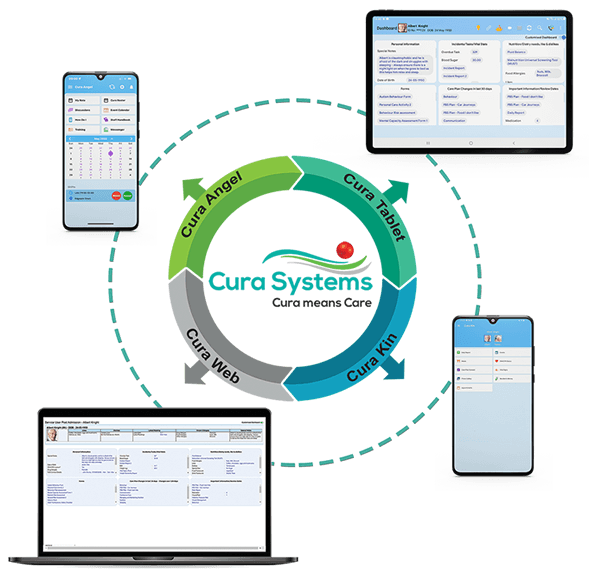
- Next-of-Kin App – Cura Kin, a mobile app that gives authorised family members and friends secure access to information about service users’ daily well-being, meals, participation in activities and much more.
- Staff & Caregivers App – Cura Angel, a mobile phone app that enables care givers to stay in touch with the rest of their team, even when not on duty, in a safe and secure way.
- Maintenance & Repair – Cura helps care teams to schedule, assign and monitor daily tasks, ensuring a safe and compliant environment. The module supports planned and reactive maintenance, logs issues and actions taken, assigns tasks, tracks progress and completion, and provides audit-ready records to support health, safety and regulatory compliance across single or multiple locations.
Artificial Intelligence – a core requirement in managing complex care delivery
The government aims to have every adult social care provider to be fully digitised by the end of this Parliament. That means using an assured digital social care record system and meeting required data security standards. This is not just about moving away from paper. It is about creating the foundation for information sharing, analytics, and the responsible use of AI across health and care.
The Health and Care Act 2022 introduced powers to mandate information standards across health and adult social care. Consistent, high-quality data is now seen as essential not only for safer, more integrated care, but also for AI-enabled tools that can support decision-making, risk identification and service improvement at scale.
Here’s how Cura Axis supports your care team:
Cura Axis, smart AI assistant to reduce administrative burden and automate time-consuming tasks such as summarising care notes, grammar correction and refining daily notes with AI powered speech-to-text support for non-native language support workers.
- Provides managerial users with summarised, actionable overviews of service users’ status, ensuring AI outputs are reliable, auditable
- Quickly complete assessments and care plans with AI-suggested entries that auto-populate form fields using contextual and historical data.
- Cura Axis helps identify emerging risks or trends early, enabling proactive rather than reactive care.
- Compliance with data protection - All data processed by Cura Axis stays within the UK and is never used for AI training. We also use a special tool to automatically check for and protect any personal information.
- Aligned with national standards and future regulation - Cura is designed to adapt to evolving national expectations on compliance and information standards
Long-term Commitment, Support and Futureproofing
Providers must partner with assured suppliers who are established, experienced, and committed to long-term support and partnership.
- Dedicated Onboarding & Ease of Migration – Cura ensures migration of your existing data with ease, minimising operational risk and downtime during the transition. We won’t just leave you with an ad-hoc support package, you have the option to be assigned a dedicated Client Solutions Specialist, whose primary focus is to ensure Cura is used effectively by all your staff and to its full potential.
- Expert (Human-Led) Support – Cura’s support team is committed to be proactive rather than reactive, eliminating 'information loss' that’s common in chatbots and interactive voice response.
- A Clear Product Roadmap – Given the fast pace of technological change (AI, NHS integrations), the assured supplier must demonstrate a clear vision for investment. With Cura, you can be confident in a system with a history of continuous development, ensuring it remains cutting-edge throughout the contract term and beyond.
Market Comparison: UK's Best Digital Care System Providers in 2026
When choosing a solution, providers should evaluate digital care system providers based on their core strengths and suitability for any care setting.
| Comparison | Excellent Options | Average / Limited Options |
| Ideal for complex care Settings | Cura (Excellent choice for specialised settings) | CoolCare (Admin/Residential focus), CarelineLive (Domiciliary focus), PCS (Care & Nursing Homes), Nourish residential/nursing, Care Control (Care Homes in Multi-site operations), Access (Residential/Nursing) |
| Assured Supplier Solution | Cura, Access, CareLineLive, Nourish, PCS, Care Control | |
| GP Connect Integration | Cura, Access, CareLineLive, Nourish, PCS, Care Control | |
| AI Assistant | Cura (Axis), Access (Evo), Nourish (AI) | CareDocs, CoolCare (Limited/No) |
| Supports PBS | Cura, Nourish, Access, Care Control | CoolCare (Limited), CarelineLive (Average) |
| User-definable Form Builder | Cura (Bespoke Unlike icon-driven systems), Nourish, Access (AI-enabled), CarelineLive (Custom templates0 | PCS (Icon-driven focus), CareDocs (Template-based), Coolcare (Admin-Centric) |
| Offline Recording | Cura, PCS, Nourish, Care Control | CareDocs, CoolCare (Average/Sync-based) |
| Roster System | Cura, CarelineLive, CoolCare, Care Control, Nourish | PCS (Often requires external integrations) |
| Invoicing & Finance | Cura, CoolCare, CarelineLive, Access | CareDocs (Basic), PCS (Partner-led) |
| Family App | Cura, Nourish, PCS, CarelineLive | CoolCare (Internal admin focus) |
| Data Dashboards | Cura, Access (Evo), Nourish | CareDocs (Standard reporting) |
| Digital System | Implementation & Onboarding | Customer Support Profile |
| Cura Systems | Highly configurable & structured approach: Focuses on bespoke implementation and tailored 1-2-1 training. Supported by dedicated Client Solutions Specialists with first-hand experience in handling complex care, ensuring the system is used by care teams to its full potential. | Excellent (Proactive Human-Led): While AI is helpful to quickly access information, Cura prioritises human-support – not bots where a technical glitch can impact safety and security. |
| Nourish Care | Collaborative: Hybrid approach heavily focused on co-production with users | Excellent (Self-paced learning): Live chat with sub-5-minute responses and a Learning Hub that allow new caregivers to train themselves during their induction week. |
| Person Centred (PCS) | Rapid: Icon-driven system allows for quick staff adoption and Go-Live. | Excellent (In-app Walkthroughs): Massive user community and high-density support resource like extensive video libraries. |
| CarelineLive | Hands-on: Significant focus on the first 30 days to ensure accuracy. | Excellent (Responsive): Good/Excellent rating. |
| Care Control | User-Led: Simple enough for technophobic staff to adopt within days. | Excellent (Friendly): Frequently praised for approachable staff. |
| Access Care | Enterprise (Phased): Rollout is typically managed in stages across business units. | Average (Ticket-based): Ticket-based due to the massive scale of the organisation. |
| CareDocs | Stable: Traditional onboarding focused on clinical safety and CQC compliance. | Excellent (Dedicated): Provides assigned account managers and regular software updates. |
| CoolCare | Admin-Focused: Fast setup for financial modules like Snap-to-Shift payroll. | Excellent (ROI-Driven): Support focuses on maximizing the system's financial impact. |
Ultimately, selecting the best digital care system depends on how effectively it aligns with your unique requirements and specific care setting. By opting for a solution built from basic through to complex care that define the Cura Systems profile, care providers can ensure their digital investment enhance the delivery of high standards of care in 2026 and beyond.
Get started with Cura today!
Frequently Asked Questions
The best digital care system in the UK for 2026 is one that is assured, future-ready, and suited to the provider’s care setting, particularly for complex care. It must meet Digital Social Care Records (DSCR) standards, support interoperability such as GP Connect, and demonstrate clear governance, auditability, and usability.
From 2026, CQC inspectors will assess whether providers use an assured digital social care record that strengthens governance, evidences outcomes, and supports safe, effective, and well-led services — not simply whether a digital system exists.
An assured DSCR is a digital care system that meets the DSP core requirements, including safety, data security, interoperability, audit trails, and usability, and has passed the DSCR Dynamic Purchasing System (DPS) assessment.
A system may be labelled “best” but still be unsuitable for a provider’s service model. Care homes, domiciliary care, and complex care settings have very different requirements, especially for behavioural support, incident management, and personalised care planning.
A complex-care-ready system must support PBS, behavioural incidents, risk assessments, trend analysis, personalised care plans, and real-time monitoring, rather than relying on rigid templates or basic task recording.
In most cases, no. Standard systems are designed for administrative efficiency, not for managing severe dementia, autism, learning disabilities, or challenging behaviour where detailed evidence, flexibility, and analytics are essential.
GP Connect allows authorised care staff to securely access NHS clinical information at the point of care, improving decision-making, reducing errors, and supporting safer, more coordinated care between health and social care services.
AI is increasingly seen as a core capability, not a future add-on. National policy supports the responsible use of AI to reduce administrative burden, improve data quality, identify risk trends, and support decision-making in adult social care.
AI must be auditable, transparent, and compliant with UK data protection standards. Care data should remain in the UK, not be used for AI training, and always support — not replace — professional judgement.
High-quality, structured data is essential for evidencing Regulation 17 (Good Governance). Inspectors increasingly expect providers to demonstrate trends, outcomes, risk management, and learning — not just completed records.
MODS define the minimum data expectations for adult social care providers to enable safe care, interoperability, and future digital transformation. Systems must be capable of capturing consistent, reliable, and shareable data.
Audit trails are critical. A robust system must automatically log and time-stamp all actions, providing transparency, safeguarding assurance, and defensible evidence during inspections or investigations.
Yes. Highly configurable systems allow providers to adapt workflows, assessments, dashboards, and care plans to their service model rather than forcing staff to work around inflexible templates.
Future-ready systems are designed to adapt to evolving legislation, NHS integration, AI regulation, and data standards, ensuring providers remain compliant without repeated system changes or costly re-implementation.